20.000 colones banknote
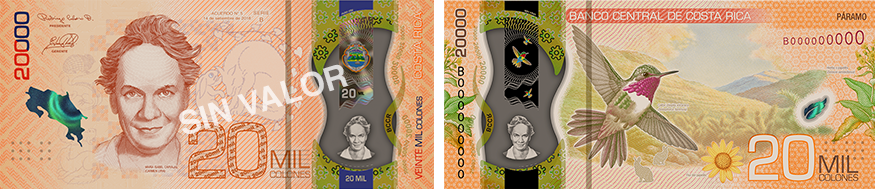
Our ¢20.000 bill. The Central Bank of Costa Rica offers new banknotes that incorporate security features identifiable simply by touching, looking at, and tilting the bill.


You may check the new banknotes with this simple procedure:
Touch - See - Turn around.
The following video of the new series of banknotes may help you better understand this system and distinguish its security features.
Features:
Paramos are ecosystems with a varied mountainous, herbaceous vegetation. They usually have no trees -and if they are found, they are small, dense, and isolated from each other- and are located in cold, inhospitable, rainy places. In Costa Rica they are found mainly on the country’s highest peaks, above 2.800 MASL, in the mountains of Chirripó, Kámuk and La Muerte (Buenavista and Vueltas, in the Talamanca Mountain Range.) They are also found at the tops of Irazú and Turrialba volcanoes, in the Central Mountain Range.
Rainfall is abundant -2.000-4.000 mm per year. Rains are not evenly distributed throughout the year. The rainiest month is October, and the driest months are February and March. Because of their location, ultraviolet rays are high, though they are reduced with cloud formation. Paramo temperatures range from 35°-86°F, occasionally dipping below zero in the early morning, with fluctuations of up to 80ºF between the minimum and the maximum temperatures in one single day.
Vegetation consists mainly of herbs and small-leave shrubs. Dwarf bamboos such as chusquea are abundant, as well as various types of grass and ferns. Small swamps called bogs, which consist mainly of partially decaying plant matter, are formed in poorly drained areas.
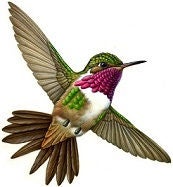
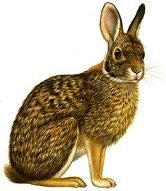
Paramos are inhabited by various species of insects and spiders, along with some mammals such as rabbits and coyotes, two lizard species, one salamander species, and some highly common birds such as Volcano Hummingbirds, Juncos, Sooty Robins, Blackbirds, and Rufous Collared Sparrows. There are no fish, despite an abundance of lakes and creeks. Some animals lower their metabolism to the point of not moving until there is enough sunlight. Visits of some mammals such as red brockets, pumas, and ocelots.
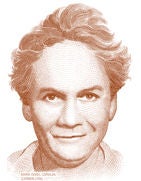
A living example of struggle and tenacity was born in 1888 - María Isabel Carvajal, a.k.a. Carmen Lyra. A unique woman, she was unhesitant in facing the whirlwinds of her time. She fought for the social and political vindications of her beloved people, marginalized sectors - a love that was reciprocal and passionate.
She earned a scholarship to continue with her studies in Pre-School Education at the Sorbonne University, in Paris. Upon her return, she founded and directed Costa Rica’s first Montessori School, located on the “Edificio Metálico” in San José, serving mainly poor children. She was also the first professor at the Chair of Children’s Literature of the Teacher’s College. Carmen Lyra’s legacy to national culture is considered of vital importance. She was the pioneer of children’s narrative in Costa Rica, and helped promote the social realistic trend in Costa Rican literature.
Ever since she was very young her social sensitivity lead her to participate in social and political activity. Her merciless fight against the government of the Tinoco brothers was a breeding ground for her combative life.
With extraordinary courage and vehemence, Carmen Lyra led students, women, and workers until destabilizing the Tinoco brothers and their ferocious dictatorship. At this point she underwent a metamorphosis, turning into an icon for her people. From this point on, she would fight with all her strength against injustice, becoming a fundamental part of popular movements of the first part of the 20th Century. She devoted herself entirely to political action.
She stood out as a journalist and was a skilled leader of Costa Rica’s Communist Party. She began her work in Literature guided by her friend Joaquín García Monge, who wrote in the Repertorio Americano magazine: "Carmen Lyra, with her incredibly modest humanity, has come to be a symbol of freedom for her country. It seemed a lie that such a petite, fragile body could harbor a women’s soul so sweet and yet so great," Gutiérrez wrote. "The teacher who had turned love and beauty into her gospel, devoting herself to children and to her country, the writer of our wildlife uncles, all full of humanism and optimism, was predestined to be also an incarnation of civic courage and of an incorruptible republican spirit of the Costa Rican people," he said.
She wrote several stories and short stories for school books, and also published some stories showing a profound commitment to the dispossessed. However, her most unforgettable work and the one which immortalized her was Los Cuentos de mi tía Panchita (Short Stories of my Aunt Panchita), which is considered to be a classic of Costa Rican literature.
She died in Mexico in 1949, where she had lived in exile since the end of the 1948 civil war. She was acknowledged as a Distinguished Citizen in July 1976.
Source: Osvaldo Valerín Ramírez, Historian.
Download the official banknote brochures containing more information on new banknotes.
Our ¢20.000 bill. The Central Bank of Costa Rica offers new banknotes that incorporate security features identifiable simply by touching, looking at, and tilting the bill.
Brochure for the new 20.000 colones bill. More secure. More durable. Recyclable material. Check both sides of the banknote in three easy steps.