2.000 colones banknote
Our ¢2.000 bill. The Central Bank of Costa Rica offers new banknotes that incorporate security features identifiable simply by touching, looking at, and tilting the bill.

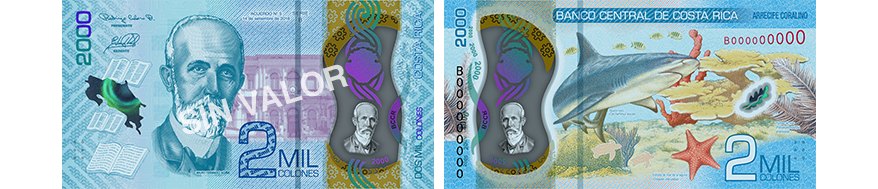
You may check the new banknotes with this simple procedure:
Touch - See - Turn around.
The following video of the new series of banknotes may help you better understand this system and distinguish its security features.
In Costa Rica there are both live and fossil coral reefs of different ages and in different parts of the territory. Along the Caribbean Coast, they may be found in Moín, Limon, Uvita Island, Cahuita, Puerto Viejo, Manzanillo, and Punta Mona. On the Pacific coast, they are found mainly in Bahía Culebra, Pelona Islands, Sámara, Dominical, Punta Mala, Gulf of Dulce, Caño Island, Cocos Island, as well as Ballena Marine National Park- the first national park of its kind created in Costa Rica and Central America.
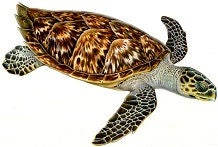
These ecosystems are found in coastal zones. Their waters are clear, warm (73°-82°F), and shallow (less than 45 m BSL). Coral reefs need stable surfaces like rocks to become adhered. They may be found near the beach, up until 1 mile off the coast. They are among the most diverse, productive, and beautiful ecosystems in the world.
With their rich colors and corals, fish, and all other organisms living around them, coral reefs may be viewed as true water gardens.
Corals adhere to the rocks or to the remains of dead corals deposited on the floor bottom for hundreds or thousands of years. They are true mountain ranges of limestone. Corals are made up of small invertebrate animals called polyps. Polyps usually live in colonies, and their tentacles have stinging cells to catch their prey.
Coral reefs have an important role in protecting beaches from waves, as well as in the constant production of sand. Some soft corals have been used with medicinal purposes. This ecosystem is highly attractive to tourists.

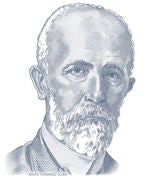
Every year on the 22nd of November Costa Ricans celebrate Teachers’ Day, honoring the memory of distinguished citizen Mauro Fernández Acuña.
Don Mauro was born on 19th of December 1843. His father, Aureliano Fernández, died as a result of the cholera epidemic that hit the country. His mother, Mercedes Acuña, had two more children, and was therefore left in a precarious situation. With great sacrifice, Mercedes provided for as much of an education as she could for her son. By the time he was 8, Mauro already spoke English and French, read the classics, played the piano, and sang.
In his adult life, he graduated as a lawyer, and worked as co-magistrate and attorney-magistrate of the Supreme Court of Justice. Fernández served the country as a member of the Constituent Assembly in 1888. He was also a deputy for the Congress of the Republic. He was a professor of Forensic Law, as well as Minister of Finance. However, his influence was most significant and everlasting as Minister of Education during the Administration of Bernardo Soto. Major changes needed to be introduced in Costa Rican education. Thus, in 1886, the General Law of Common Education (Ley General de Educación Común) was passed, and as a result the country’s education would take a fundamentally scientific approach and would be more practice-oriented.
With his educational reform, Mauro Fernández accomplished major achievements, such as teacher instruction;implementing modern teaching methods, and organizing the curricula. New schools were opened, e.g. the emblematic Liceo de Costa Rica, the Instituto de Alajuela, the Colegio Superior de Señoritas, and the Escuela Normal (Teachers’ College).
Furthermore, curricula were approved for obtaining a high-school degree through sufficiency tests. The Organic Regulations for Graduate Education Schools, and higher education institutions were created for Agriculture, Pharmacy, and Music. A school statistics office was also created, as well as the education boards, El Maestro magazine, and school warehouses.
Source: Osvaldo Valerín Ramírez, Historian
Download the official banknote brochures containing more information on new banknotes.
Our ¢2.000 bill. The Central Bank of Costa Rica offers new banknotes that incorporate security features identifiable simply by touching, looking at, and tilting the bill.
Brochure for the new 2.000 colones bill. More secure. More durable. Recyclable material. Check both sides of the banknote in three easy steps.