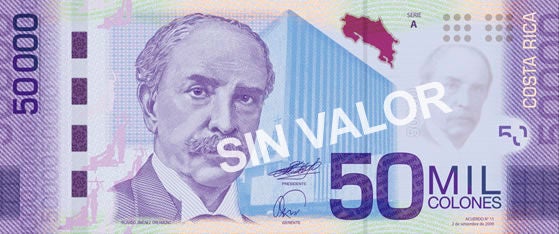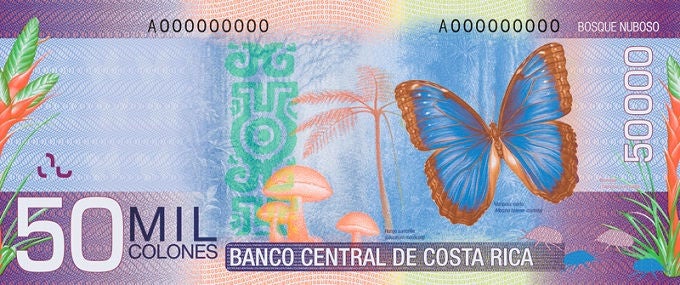
| Features | A | B | C |
|---|---|---|---|
| Quantity (units) | 19.300.000 | 19.833.592 | 40.000.000 |
| Beginning number | 000 000 001 | 000 000 001 | 000 000 001 |
| Ending number | 21 250 000 | 20 841 295 | 44 894 523 |
| Agreement of the Board of Directors | No. 11 of September 2, 2009 | No. 3 of September 19, 2012 | No. 5 of September 14, 2018 |
| Signature of the President of the BCCR | Francisco de Paula Gutiérrez Gutiérrez | Rodrigo Bolaños Zamora | Rodrigo Cubero Brealey |
| Signature of the Manager of the BCCR | Roy González Rojas | Félix Delgado Quesada | Eduardo Prado Zúñiga |
| Date of entry into circulation | August 27, 2012 | November 21, 2016 | December 1, 2020 |

Banknote denominations
Select the subtopic of your interest:
1.000 colones banknote
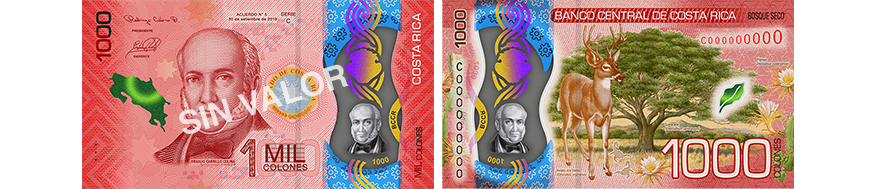
Security features:
You may check the new banknotes with this simple procedure:
Touch - See - Turn around.
The following video of the new series of banknotes may help you better understand this system and distinguish its security features.
Banknote care
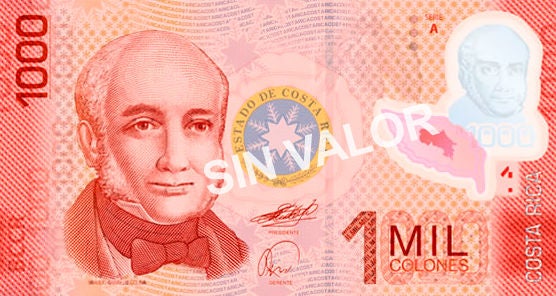
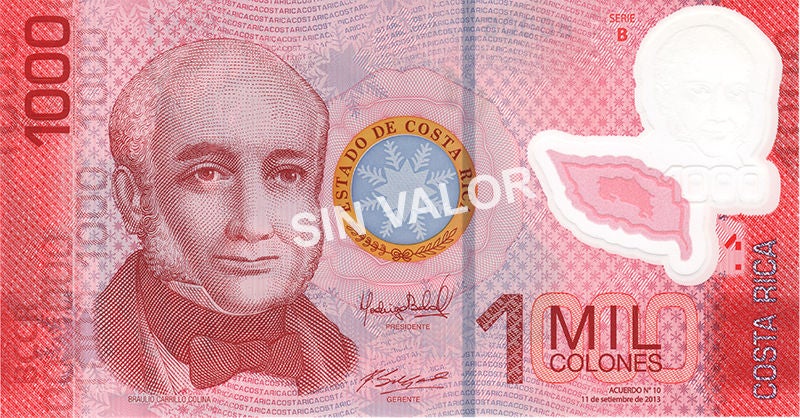
Features:
- Denomination: 1.000
- Circulating Banknotes Series: C.
- Size (in mm): 125 long * 67 width
- Material: Polymer
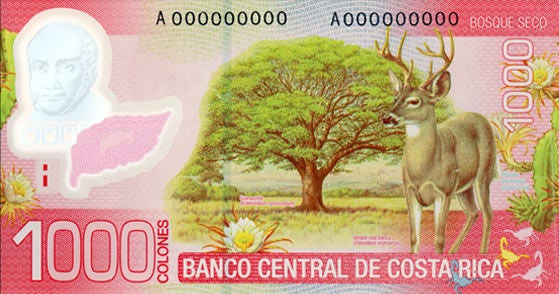
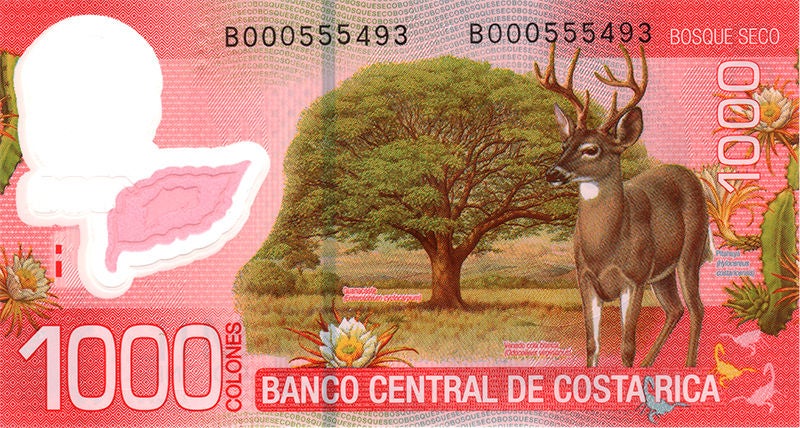
Biodiversity:
In Costa Rica, the tropical dry forest is found in the lowlands, from 0-700 meters above sea level (MASL), in the Guanacaste province and in the northern part of the Puntarenas province, in the surroundings of River Tarcoles. This ecosystem changes gradually toward the south, as climate conditions there favor the tropical rainforest.
A marked dry season, stretching from November to March, is the main factor conditioning species adaptations in tropical dry forests, e.g. leaf falling to reduce water loss, animal migration toward wetter zones, and an abundance of cacti. During the rainy season the loss of humidity is intensified by heavy trade winds, thereby favoring dispersal of certain seeds.

During the rainy season, the dry forest receives 900-1700 mm of rainfall annually. With the arrival of rains, the forest changes radically: with an increase in humidity, leaves come out and forests are covered with green, there is less light available within them, and many seeds sprout.
Animals that had moved away in search of water and food come back for breeding. Birds sing while building their nests, indicating that the time has come to nest and raise their chicks.
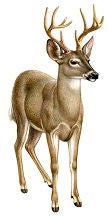
Fauna in these forests is as rich as its flora. It is home to howler monkeys, spider monkeys, white-headed capuchins, deer, coatis, peccaries, Desmarest's spiny pocket mice, Central American agoutis, cougars, armadillos, magpies, trogons, parrots, and a great diversity of insects and spiders, among other groups.
Notable citizen portrayed:
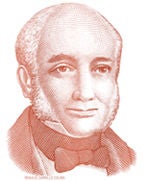
Braulio Carrillo was born in San Rafael de Oreamuno, Cartago, on the 20th of March 1800. He studied Law and graduated as an attorney. He was a Magistrate for the Supreme Court of Justice, which he then came to preside. He was elected as Deputy to Congress, and in 1828 became President of Congress. Additionally, Carrillo represented Costa Rica before the Federate Congress.
Carrillo was Head of State on two occasions. From 1835 to 1837 and again in 1838 as a result of a coup d’état. He was recognized as President by Congress on the 26th of June, was sworn two days later, and remained in power until 1842. He ruled with an iron fist, instilling values like honesty, morality, and hard work. Carrillo enthusiastically promoted the country’s development, bringing about progress and order in Public Administration.
During his administrations, he abolished the so-called Ambulance Law (Ley de la Ambulancia.) He firmly fought idleness and vice, abolishing holidays and religious festivities to this end. He also paid off the country’s foreign debt, and on the 8th of November 1838 he broke ties with the Central American Federation, declaring Costa Rica "a free and independent State."
Under his administration, the road to Matina was built and inaugurated, thereby saving the country in costs for exporting coffee through the Pacific coast. He also enacted the so-called Carrillo General Code (Código General Carillo), the first piece of legislation containing rules on civil and criminal law with their respective procedures, and set up the Judicial System. It was this way that Braulio Carrillo completed the country’s independence from Spain -until that time, it was Spanish laws that were enforced. He ordered by decree the creation of the courts of justice and juzgados, and established custom tariffs and regulations for the public treasury and for the Police. In 1842, Francisco Morazán invaded Costa Rica and Carrillo was deposed. He sought exile in El Salvador, where he was killed on the 15th of March 1845. In 1971 he was declared a Distinguished Citizen and Architect of Costa Rican State by Congress.
Source: Osvaldo Valerín Ramírez, Historian
Emision details
The Central Bank of Costa Rica makes available to the public a family of banknotes carefully designed to facilitate economic transactions, ensure transaction security, and reflect the country's cultural and natural wealth.
| Features | A | B | C |
|---|---|---|---|
| Quantity (units) | 40.000 000 | 20.000 000 | 45.000 000 |
| Beginning number | 000 000 001 | 000 000 001 | 000 000 001 |
| Ending number | 042 000 000 | 021 599 999 | 049 075 117 |
| Agreement of the Board of Directors | No.11, of September 2, 2009 | No. 10 of September 11, 2013 | No. 5 of September 20, 2019 |
| Signature of the President of the BCCR | Francisco de Paula Gutiérrez Gutiérrez | Rodrigo Bolaños Zamora | Rodrigo Cubero Brealey |
| Signature of the Manager of the BCCR | Roy González Rojas | Félix Delgado Quesada | Eduardo Prado Zúñiga |
| Date of entry into circulation | June 20, 2011 | December 2, 2016 | October 15, 2021 |
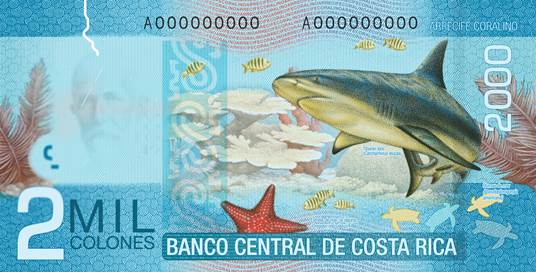
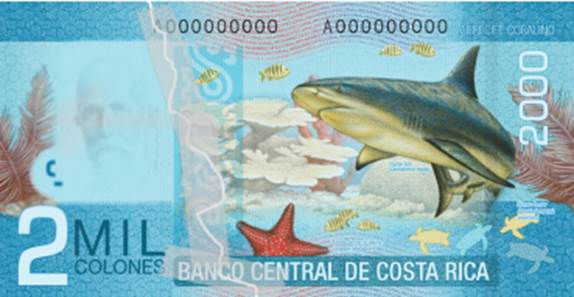
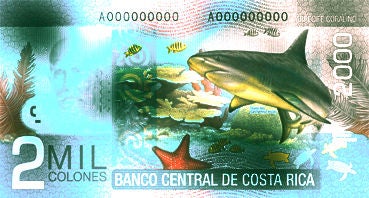
2.000 colones banknote
Security features:
You may check the new banknotes with this simple procedure:
Touch - See - Turn around.
The following video of the new series of banknotes may help you better understand this system and distinguish its security features.
Banknote care
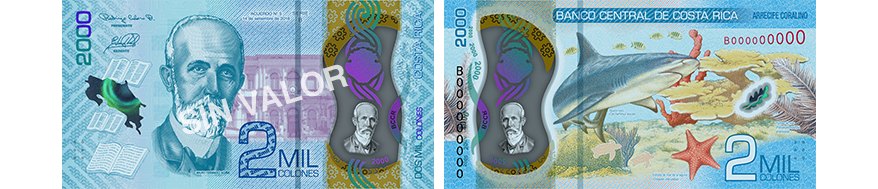
Features:
- Denomination: 2.000
- Circulating Banknotes Series: B.
- Size (in mm): 132 long * 67 width
- Material: Polymer
Biodiversity:
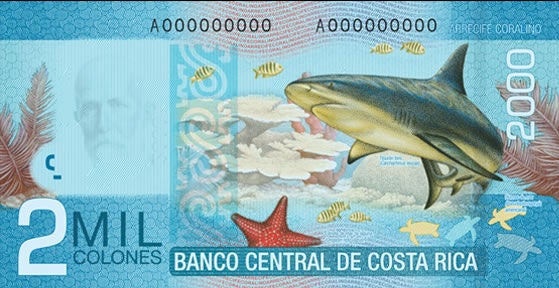
In Costa Rica there are both live and fossil coral reefs of different ages and in different parts of the territory. Along the Caribbean Coast, they may be found in Moín, Limon, Uvita Island, Cahuita, Puerto Viejo, Manzanillo, and Punta Mona. On the Pacific coast, they are found mainly in Bahía Culebra, Pelona Islands, Sámara, Dominical, Punta Mala, Gulf of Dulce, Caño Island, Cocos Island, as well as Ballena Marine National Park- the first national park of its kind created in Costa Rica and Central America.
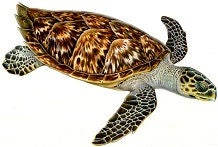
These ecosystems are found in coastal zones. Their waters are clear, warm (73°-82°F), and shallow (less than 45 m BSL). Coral reefs need stable surfaces like rocks to become adhered. They may be found near the beach, up until 1 mile off the coast. They are among the most diverse, productive, and beautiful ecosystems in the world.
With their rich colors and corals, fish, and all other organisms living around them, coral reefs may be viewed as true water gardens.
Corals adhere to the rocks or to the remains of dead corals deposited on the floor bottom for hundreds or thousands of years. They are true mountain ranges of limestone. Corals are made up of small invertebrate animals called polyps. Polyps usually live in colonies, and their tentacles have stinging cells to catch their prey.
Coral reefs have an important role in protecting beaches from waves, as well as in the constant production of sand. Some soft corals have been used with medicinal purposes. This ecosystem is highly attractive to tourists.

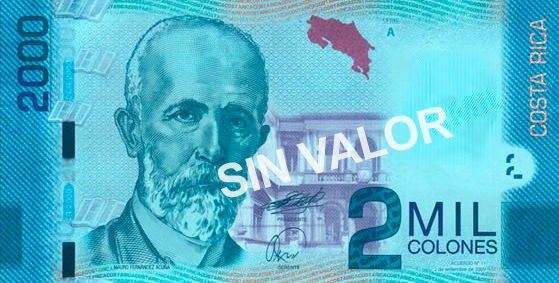
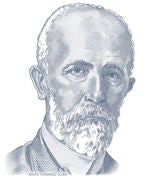
Every year on the 22nd of November Costa Ricans celebrate Teachers’ Day, honoring the memory of distinguished citizen Mauro Fernández Acuña.
Don Mauro was born on 19th of December 1843. His father, Aureliano Fernández, died as a result of the cholera epidemic that hit the country. His mother, Mercedes Acuña, had two more children, and was therefore left in a precarious situation. With great sacrifice, Mercedes provided for as much of an education as she could for her son. By the time he was 8, Mauro already spoke English and French, read the classics, played the piano, and sang.
Notable citizen portrayed:
In his adult life, he graduated as a lawyer, and worked as co-magistrate and attorney-magistrate of the Supreme Court of Justice. Fernández served the country as a member of the Constituent Assembly in 1888. He was also a deputy for the Congress of the Republic. He was a professor of Forensic Law, as well as Minister of Finance. However, his influence was most significant and everlasting as Minister of Education during the Administration of Bernardo Soto. Major changes needed to be introduced in Costa Rican education. Thus, in 1886, the General Law of Common Education (Ley General de Educación Común) was passed, and as a result the country’s education would take a fundamentally scientific approach and would be more practice-oriented.
With his educational reform, Mauro Fernández accomplished major achievements, such as teacher instruction;implementing modern teaching methods, and organizing the curricula. New schools were opened, e.g. the emblematic Liceo de Costa Rica, the Instituto de Alajuela, the Colegio Superior de Señoritas, and the Escuela Normal (Teachers’ College).
Furthermore, curricula were approved for obtaining a high-school degree through sufficiency tests. The Organic Regulations for Graduate Education Schools, and higher education institutions were created for Agriculture, Pharmacy, and Music. A school statistics office was also created, as well as the education boards, El Maestro magazine, and school warehouses.
Source: Osvaldo Valerín Ramírez, Historian
Emision details
The Central Bank of Costa Rica makes available to the public a family of banknotes carefully designed to facilitate economic transactions, ensure transaction security, and reflect the country's cultural and natural wealth.
| Features | A | B | |||
|---|---|---|---|---|---|
| Quantity (units) | 35.028.000 | 20.000 000 | 20.000 000 | 40.000 000 | 18 910 000 |
| Beginning number | 000 000 001 | 41 400 001 | 63 000 001 | 000 000 001 | 43 569 010 |
| Ending number | 41 400 000 | 63 000 000 | 83 999 999 | 43 569 009 | 67 568 999 |
| Agreement of the Board of Directors | No. 11 of September 2, 2009 | No. 10 of September 11, 2013 | No. 6 of September 16, 2015 | No. 5 del 14 de setiembre de 2018 | No. 8 del 7 de setiembre de 2022 |
| Signature of the President of the BCCR | Francisco de Paula Gutiérrez Gutiérrez | Rodrigo Bolaños Zamora | Olivier Castro Pérez | Rodrigo Cubero Brealey | Róger Madrigal López |
| Signature of the Manager of the BCCR | Roy González Rojas | Félix Delgado Quesada | Eduardo Prado Zúñiga | Eduardo Prado Zúñiga | Hazel Valverde Richmond |
| Date of entry into circulation | June 20, 2011 | May 12, 2015 | November 15, 2017 | December 1, 2020 | November 26, 2024 |
5.000 colones banknotes
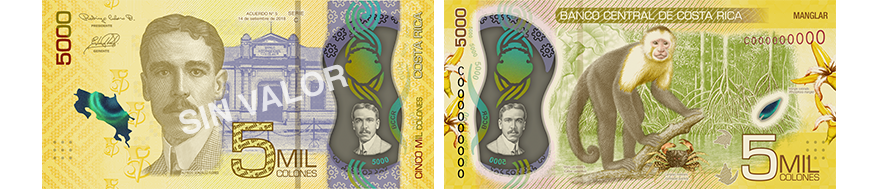
Security features:
You may check the new banknotes with this simple procedure:
Touch - See - Turn around.
The following video of the new series of banknotes may help you better understand this system and distinguish its security features.
Banknote care
Features:
- Denomination: 5.000
- Circulating Banknotes Series: C.
- Size (in mm): 139 long * 67 width
- Material: Polymer
Biodiversity:
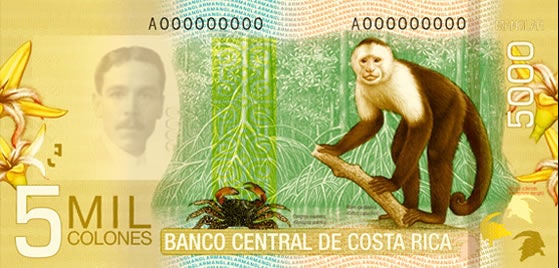
On Costa Rica’s Pacific coast mangroves are located mainly in the mouths of rivers Tempisque, Bebedero, Tarcoles, Térraba, and Sierpe; in the gulfs of Papagago, Nicoya, and Dulce; and in the bays of Santa Elena, Salinas, Tamarindo, and Herradura. On the Caribbean coast they are located in Moín, and in the pond/lake* of Gandoca. Mangroves make up for nearly 1 percent of the country’s territory. During the high tide, these forests are flooded with salt water. In mangroves located on river mouths water is less saline, as it is mixed with fresh water.
A great diversity of species found in mangroves is a result of the fact that in these ecosystems there is a high production of organic matter and there are different environments, which are the result of variations in salinity. These coastal forests are used by huge amounts of sea animals to lay their eggs, feed, and grow, and they also provide shelter and food to significant amounts of birds, mammals, and insects.
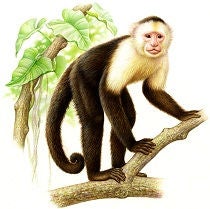
In Costa Rica there are several mangrove species, with common names such as red mangrove, silver-leaved buttonwood, black mangrove, and white mangrove, and button mangrove. Shells, crabs, snails, as well as shrimp and fish larvae inhabit their leaves, creating highly complex communities. On their treetops live countless birds such as herons, snakes, white-headed capuchins, raccoons, lizards, and bats. There are also countless crickets, mosquitoes, biting flies, spiders, and scorpions.

Notable citizen portrayed:
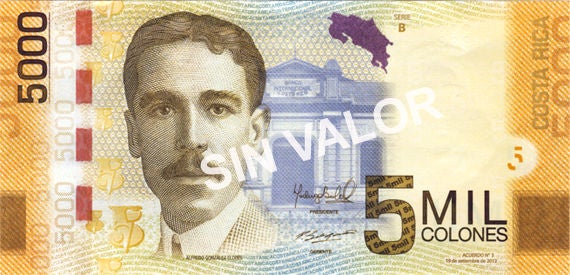
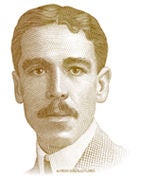
On the 15th of July 1877 there was unusual joy and hustle at the home of Elemberta Flores and Domingo González. She gave birth to one of Costa Rica’s most distinguished citizens - Alfredo González Flores.
He completed high school at the Liceo de Costa Rica, and eventually specialized in Law and Economics. Both of these served to provide the country with highly valuable services - first as a Deputy in Congress, and then as President of the Republic.
In 1910, while serving in Congress, he was appointed as First Designated Member of the President, and as such he was called to exercise as President of the Republic from 1914 to 1917. He came to power because in the 1914 elections no candidate obtained an absolute majority. Thus, a twist of fate gave Costa Rica one of its most progressive governments of all time.
Those who believe that the President would be easily persuadable would be proven wrong. González Flores was a statesman, a visionary man with an extraordinary intellectual capacity. He was convinced that the country needed a change in course to take the path to a more integrated development. His economic and social reforms were definitive, including, for example, the non-convertibility of currency, savings, control of gold reserves, bond issuance, creation of banks, as well as introducing property and income taxes -under the premise that the rich should pay as such, and the poor should pay as such.
González Flores was enlightened and ahead of his time, but his revolutionary measures touched upon major vested interests. Thus, Federico Tinoco, who was his Minister of Defense, overthrew him on the 27th of January 1917. González Flores was exiled in the United States. He remained on the fringes of party politics upon his return to the country, although he did serve the country in countless public offices with dignity and transparency.
Source: Osvaldo Valerín Ramírez, Historian.
Emision details
The Central Bank of Costa Rica makes available to the public a family of banknotes carefully designed to facilitate economic transactions, ensure transaction security, and reflect the country's cultural and natural wealth.
10.000 colones banknotes
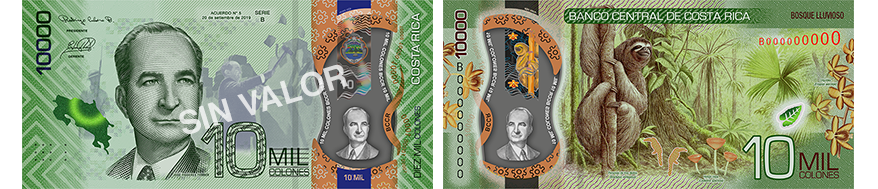
Security features:
You may check the new banknotes with this simple procedure:
Touch - See - Turn around.
The following video of the new series of banknotes may help you better understand this system and distinguish its security features.
Banknote care
Features:
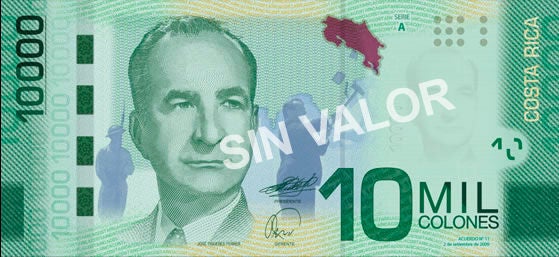
- Denomination: 10.000
- Circulating Banknotes Series: B.
- Size (in mm): 146 long * 67 width
- Material: Polymer

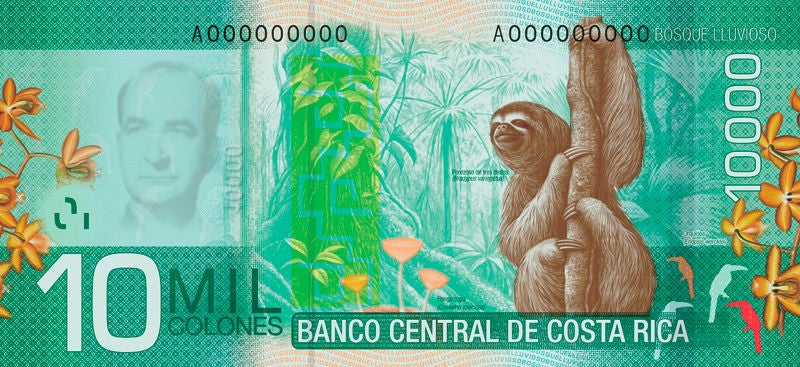
Biodiversity:
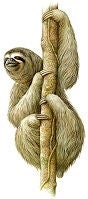
The tropical rainforest is one of the world’s most diverse and exuberant ecosystems. In Costa Rica it used to cover the largest share of the territory, as it may be found in lowlands -up to 700 MASL, and in heavily rainy places like the Central and Southern Pacific Zones, the Northern Zone, and the Caribbean. Due to extensive deforestation towards the end of the past century, rainforests are today highly fragmented, and their largest remainders are protected as national parks and biological reserves.
This is a complex and dense ecosystem, with trees as high as 130-180 feet. Trees usually have an umbrella-like shape with wide crowns and long trunks, quite often with high, smooth, and slender buttress roots.
This forest is more diverse in terms of plants and animals per unit than any other type of forest. More animal species may be found in one single tree of a tropical rainforest than in an entire forest in a higher altitude. Various forms of animal and plant life live in a great variety of specialized environments located in different forest strata.
Source: INBioparque
Notable citizen portrayed:
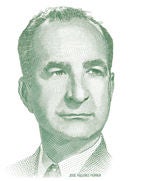
This man of a profound, innovative thinking was born on the 25th of September 1906. He studied in the United States, and settled in his farm "La Lucha" upon returning to Costa Rica, where he started growing pita and coffee. Yet fate had a different life ahead for is country life-lover turned into an entrepreneur. He decided to raise his voice as he disagreed with the path the country was taking. In his view, democracy was being tarnished, and civil freedoms were no longer being upheld. In 1942 he gave a speech on the radio explaining his dissatisfaction with the Government -a speech he could not finish. He was taken prisoner and subsequently deported to Mexico. And that was where it all started.
José Figueres rose in arms in 1948, when Congress annulled the elections whose legitimate winner was Otilio Ulate Blanco. His friend Francisco Orlich opened up a second battle front in the country’s northern region. Costa Rica was now in civil war. The government’s forces deposed arms after a little more than four months, Figueres went into San José, acclaimed as a hero.
Laying the foundations for modern Costa Rica, the Founding Board of the Second Republic was established, and was presided over by Figueres. The board’s decrees strengthened democracy, and it had highly significant social achievements. And in a magnificent example to the world, the Army was dissolved by decree. On the 7th of November 1949, a new Political Constitution entered into force -and continues to be in force.
The next day, the Board handed over power to Otilio Ulate. Figueres Ferrer founded the National Liberation Party on 12th of October 1951, a party which took him to the Presidency twice (1953-1958, 1970-1974). His administrations account for many accomplishments, the following being among them:
- Costa Rica’s Electricity Institute (ICE) was created (ICE)
- The Banking System was nationalized
- The National Institute of Housing and Town Planning was created
- The Costa Rican Board of Tourism was created
- The Mixed Institute of Social Assistance was created
- The General Directorate of Social Adapting was created
- Costa Rica’s Technological Institute was created
- The Ministry of Culture, Youth and Sports was created
- The Atlantic Railroad was nationalized
- The National Symphonic Orchestra was created
- The National University was created
- The National Comission of Indigenous Matters was created
- A Family Code was passed
- Costa Rica’s Oil Refinery (RECOPE) was nationalized
- The Social Security System attained a universal coverage
- All hospitals were passed to be under the administration of the Costa Rican Social Security System (CCSS).
The Costa Rica of today has José Figueres indelible mark. His fights and commitments make him the most significant public figure and ruler in the country’s history. Thus he was declared Costa Rican Character of the 20th Century. The leader of the Second Republic died on 8th of June 1990, and was declared a Distinguished Citizen on 12th of November of that year
Source: Osvaldo Valerín Ramírez, Historian.
Emision details
The Central Bank of Costa Rica makes available to the public a family of banknotes carefully designed to facilitate economic transactions, ensure transaction security, and reflect the country's cultural and natural wealth.
| Features | A | B | ||
|---|---|---|---|---|
| Quantity (units) | 64.436.000 | 30.000.000 | 65.000.000 | 20 000 000 |
| Beginning number | 000 000 001 | 86 000 001 | 000 000 001 | 69 164 801 |
| Ending number | 86 000 000 | 120 498 995 | 069 164 800 | 90 720 000 |
| Agreement of the Board of Directors | No. 11 of September 2, 2009 | No. 6 of September 10, 2014 | No. 5 of September 20, 2019 | No. 8 of September 7, 2022 |
| Signature of the President of the BCCR | Francisco de Paula Gutiérrez Gutiérrez | Olivier Castro Pérez | Rodrigo Cubero Brealey | Róger Madrigal López |
| Signature of the Manager of the BCCR | Roy González Rojas | Eduardo Prado Zúñiga | Eduardo Prado Zúñiga | Hazel Valverde Richmond |
| Date of entry into circulation | August 27, 2012 | December 6, 2017 | October 15, 2021 | November 25, 2024 |
20.000 colones banknotes
Security features:
You may check the new banknotes with this simple procedure:
Touch - See - Turn around.
The following video of the new series of banknotes may help you better understand this system and distinguish its security features.
Banknote care
Features
Features:
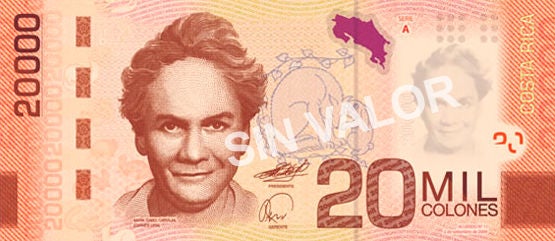
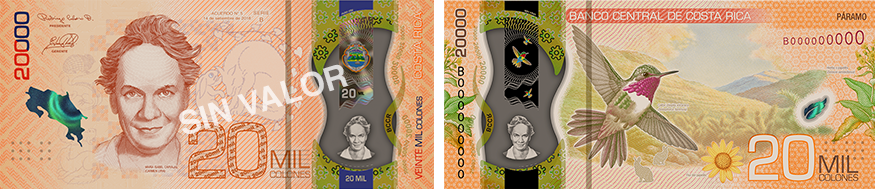
- Denomination: 20.000
- Circulating Banknotes Series: B.
- Size (in mm): 153 long * 67 width
- Material: Polymer
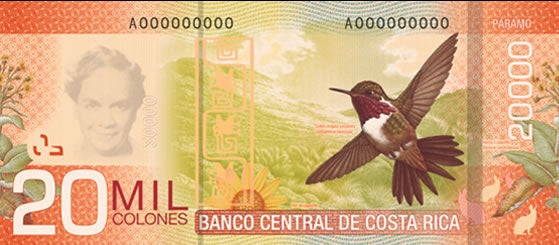
Biodiversity:
Paramos are ecosystems with a varied mountainous, herbaceous vegetation. They usually have no trees -and if they are found, they are small, dense, and isolated from each other- and are located in cold, inhospitable, rainy places. In Costa Rica they are found mainly on the country’s highest peaks, above 2.800 MASL, in the mountains of Chirripó, Kámuk and La Muerte (Buenavista and Vueltas, in the Talamanca Mountain Range.) They are also found at the tops of Irazú and Turrialba volcanoes, in the Central Mountain Range.
Rainfall is abundant -2.000-4.000 mm per year. Rains are not evenly distributed throughout the year. The rainiest month is October, and the driest months are February and March. Because of their location, ultraviolet rays are high, though they are reduced with cloud formation. Paramo temperatures range from 35°-86°F, occasionally dipping below zero in the early morning, with fluctuations of up to 80ºF between the minimum and the maximum temperatures in one single day.

Vegetation consists mainly of herbs and small-leave shrubs. Dwarf bamboos such as chusquea are abundant, as well as various types of grass and ferns. Small swamps called bogs, which consist mainly of partially decaying plant matter, are formed in poorly drained areas.
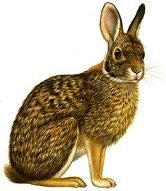
Paramos are inhabited by various species of insects and spiders, along with some mammals such as rabbits and coyotes, two lizard species, one salamander species, and some highly common birds such as Volcano Hummingbirds, Juncos, Sooty Robins, Blackbirds, and Rufous Collared Sparrows. There are no fish, despite an abundance of lakes and creeks. Some animals lower their metabolism to the point of not moving until there is enough sunlight. Visits of some mammals such as red brockets, pumas, and ocelots.
Notable citizen portrayed:
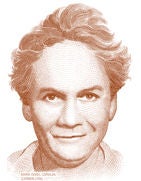
A living example of struggle and tenacity was born in 1888 - María Isabel Carvajal, a.k.a. Carmen Lyra. A unique woman, she was unhesitant in facing the whirlwinds of her time. She fought for the social and political vindications of her beloved people, marginalized sectors - a love that was reciprocal and passionate.
She earned a scholarship to continue with her studies in Pre-School Education at the Sorbonne University, in Paris. Upon her return, she founded and directed Costa Rica’s first Montessori School, located on the “Edificio Metálico” in San José, serving mainly poor children. She was also the first professor at the Chair of Children’s Literature of the Teacher’s College. Carmen Lyra’s legacy to national culture is considered of vital importance. She was the pioneer of children’s narrative in Costa Rica, and helped promote the social realistic trend in Costa Rican literature.
Ever since she was very young her social sensitivity lead her to participate in social and political activity. Her merciless fight against the government of the Tinoco brothers was a breeding ground for her combative life.
With extraordinary courage and vehemence, Carmen Lyra led students, women, and workers until destabilizing the Tinoco brothers and their ferocious dictatorship. At this point she underwent a metamorphosis, turning into an icon for her people. From this point on, she would fight with all her strength against injustice, becoming a fundamental part of popular movements of the first part of the 20th Century. She devoted herself entirely to political action.
She stood out as a journalist and was a skilled leader of Costa Rica’s Communist Party. She began her work in Literature guided by her friend Joaquín García Monge, who wrote in the Repertorio Americano magazine: "Carmen Lyra, with her incredibly modest humanity, has come to be a symbol of freedom for her country. It seemed a lie that such a petite, fragile body could harbor a women’s soul so sweet and yet so great," Gutiérrez wrote. "The teacher who had turned love and beauty into her gospel, devoting herself to children and to her country, the writer of our wildlife uncles, all full of humanism and optimism, was predestined to be also an incarnation of civic courage and of an incorruptible republican spirit of the Costa Rican people," he said.
She wrote several stories and short stories for school books, and also published some stories showing a profound commitment to the dispossessed. However, her most unforgettable work and the one which immortalized her was Los Cuentos de mi tía Panchita (Short Stories of my Aunt Panchita), which is considered to be a classic of Costa Rican literature.
She died in Mexico in 1949, where she had lived in exile since the end of the 1948 civil war. She was acknowledged as a Distinguished Citizen in July 1976.
Source: Osvaldo Valerín Ramírez, Historian.
Emision details
The Central Bank of Costa Rica makes available to the public a family of banknotes carefully designed to facilitate economic transactions, ensure transaction security, and reflect the country's cultural and natural wealth.
| Features | A | B | |
|---|---|---|---|
| Quantity (units) | 18.064.523 | 19.080.000 | 40.000.000 |
| Beginning number | 000 000 001 | 31 900 001 | 000 000 00 |
| Ending number | 31 900 000 | 53 691 250 | 046 421 826 |
| Agreement of the Board of Directors | No. 11 of September 2, 2009 | No. 3 of September 19, 2012 | No. 5 of September 14, 2018 |
| Signature of the President of the BCCR | Francisco de Paula Gutiérrez Gutiérrez | Rodrigo Bolaños Zamora | Rodrigo Cubero Brealey |
| Signature of the Manager of the BCCR | Roy González Rojas | Félix Delgado Quesada | Eduardo Prado Zúñiga |
| Date of entry into circulation | September 22, 2010 | July 15, 2014 | November 26, 2020 |
Damaged banknotes
Damage to banknotes is directly related to their handling, as well as to other aspects related to the environment in which they are used, such as humidity.
Banknotes are made so that they can be safely used for a definite period, known as their lifespan. However, the lifespans of many banknotes are reduced by bad handling.
Below are some simple tips to help extend banknote lifespan:
- Do not crumple them unnecessarily
- Do not staple them
- Do not scratch them
- Do not write, place stamps or draw on them
- Do not expose them to humidity or fire
- If a banknote is torn, repair it with adhesive tape and deposit it in the nearest bank.
Damaged banknotes
Damaged banknotes are withdrawn from circulation following the guidelines set forth by the Banco Central de Costa Rica, because damaged banknotes are difficult to identify and handle.
It is important to keep in mind that damaged banknotes can be changed if:
- Their authenticity can be verified
- Their denomination can be verified
- The front and back sides are preserved.
Below are the criteria set forth by the Banco Central de Costa Rica for changing damaged banknotes:
Deformed banknote:
- If the banknote has all its parts, it should be possible to change it.
- If a segment of the banknote is missing, a complete segment with at least 60% of the new dimension of the banknote must be preserved for the banknote to be changed.
Mutilated banknote:
- If the banknote is missing an area of less than 12 sq cm, it may be changed.
- If the missing area is over 12 sq cm, the banknote may be changed if it has a complete segment of at least 60% of its original size.
Repaired banknote:
- If the repaired banknote is complete, it may be changed.
- If a segment is missing, it may be changed according to the rules defined for cases of mutilated banknotes.
Contaminated banknote:
- Banknotes must be decontaminated before they are presented to be changed.
Damaged banknotes in cotton
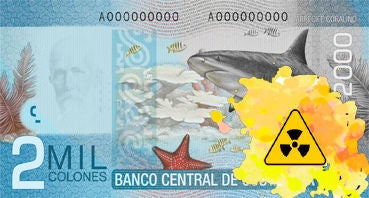
Contaminated banknote
Damaged banknote
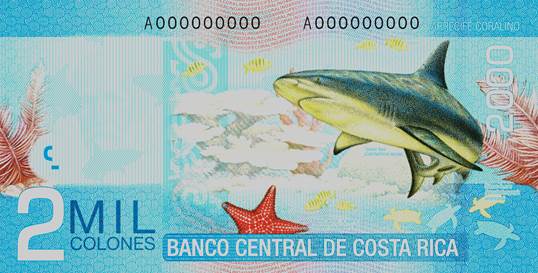
Discolored banknote

Deformed banknote
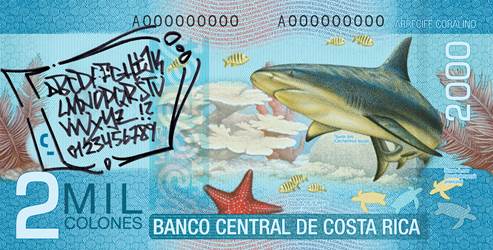
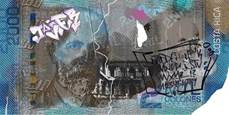
Graffiti marked banknote
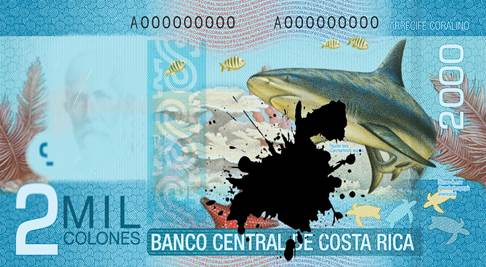
Stained banknote
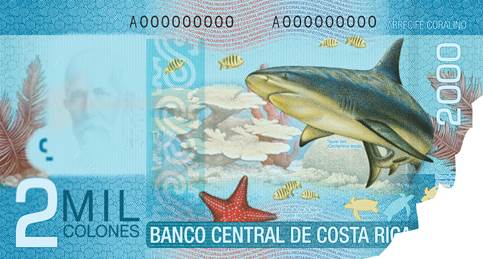
Mutilated banknote
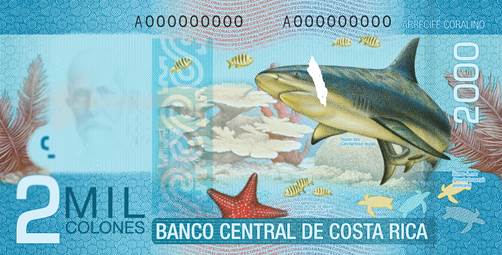
Perforated banknote
Torn banknote
Repaired banknote
Soiled banknote
Banknotes out of circulation
The following notes no longer in circulation:
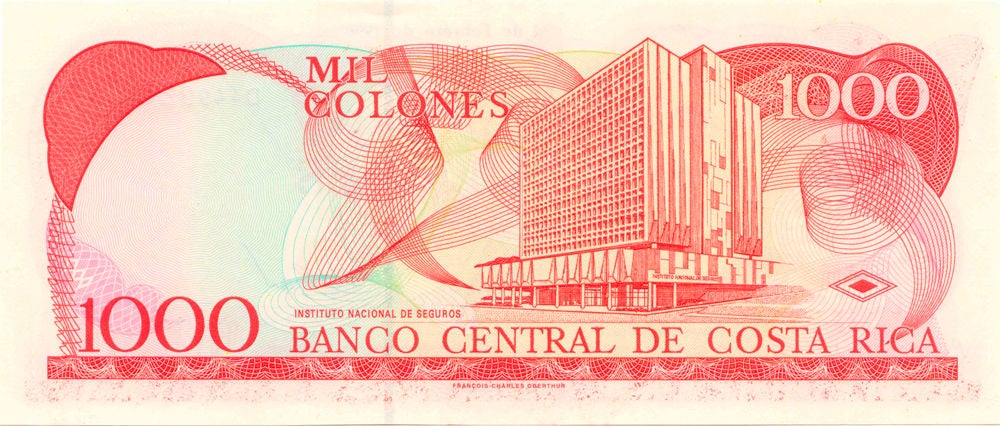
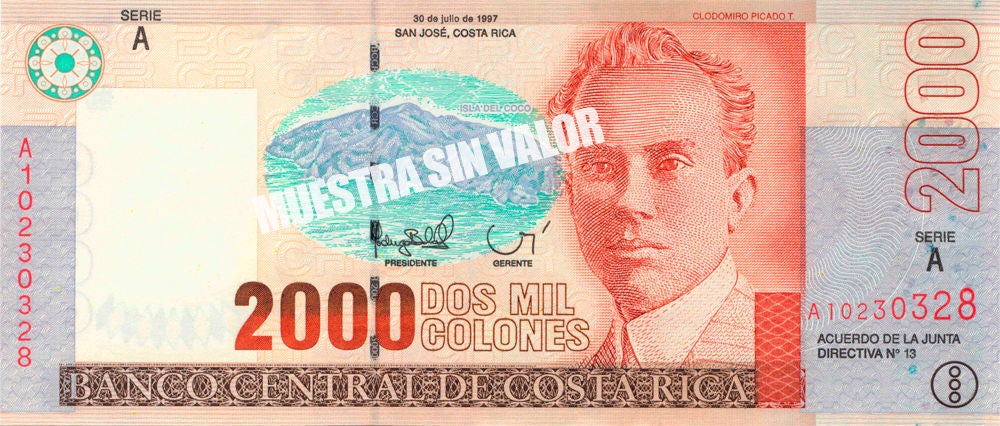
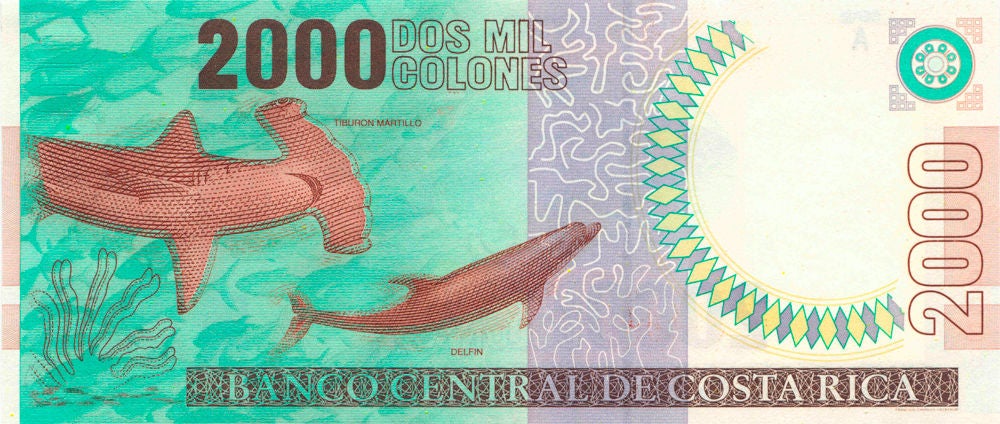
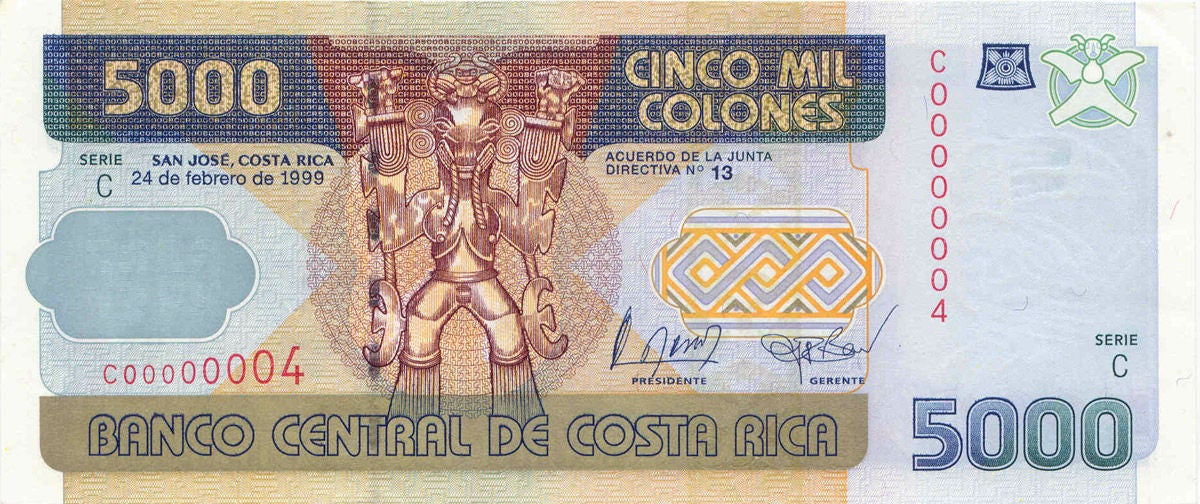
Banknotes issued before 2011
| Denomination | Size (in mm.) | Out of circulating banknotes series | Material | End date of circulation |
|---|---|---|---|---|
| ₡1.000 | 156 long * 67 width | A, B, C y D | Cotton | September 1, 2011 |
| ₡2.000 | 156 long * 67 width | A | Cotton | September 1, 2011 |
| ₡5.000 | 156 long * 67 width | A, B y C | Cotton | December 31, 2012 |
| ₡10.000 | 156 long * 67 width | A | Cotton | December 31, 2012 |
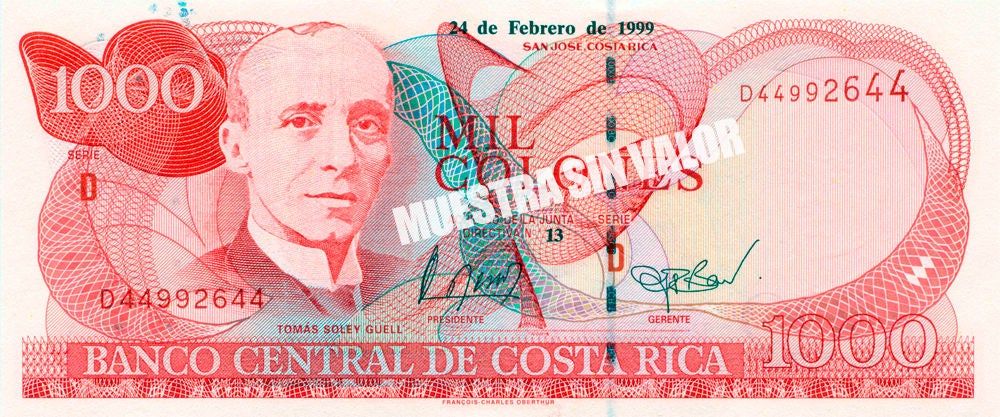
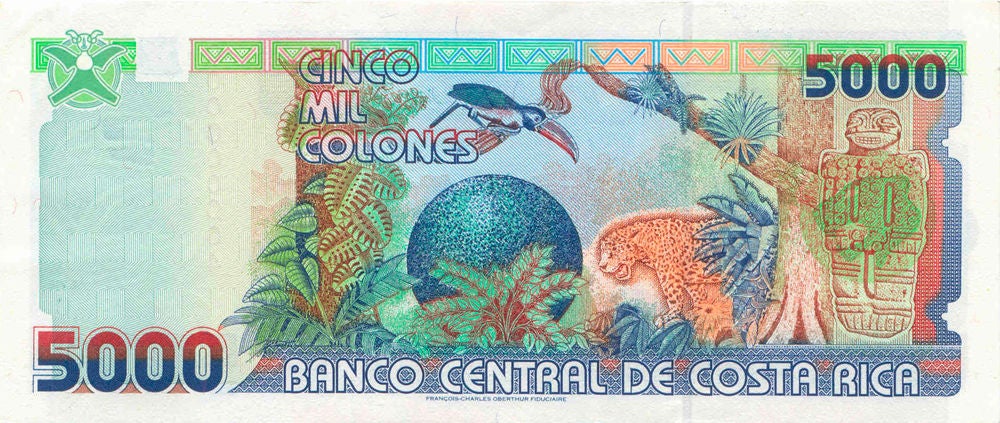
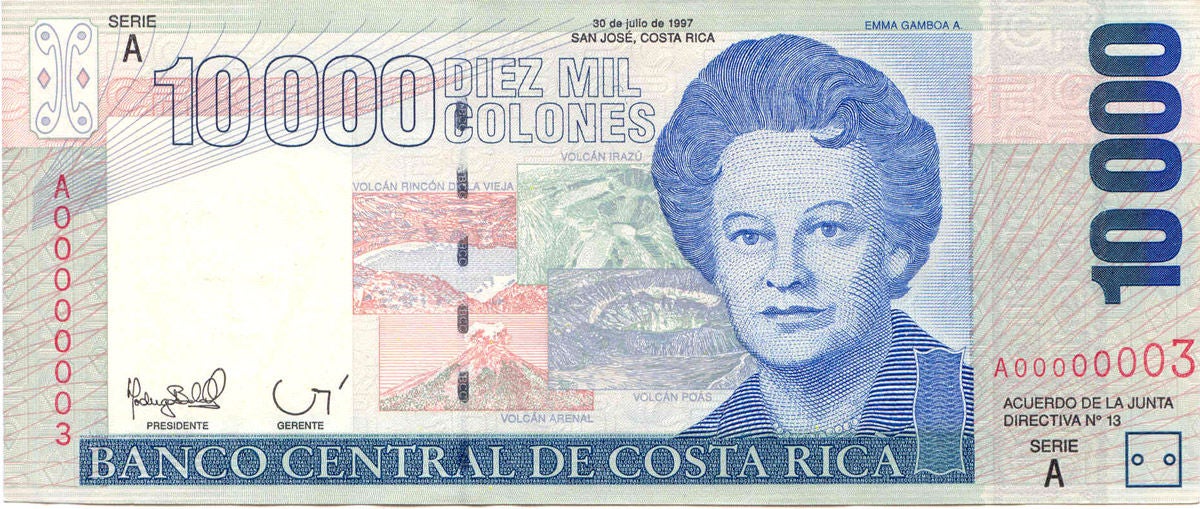
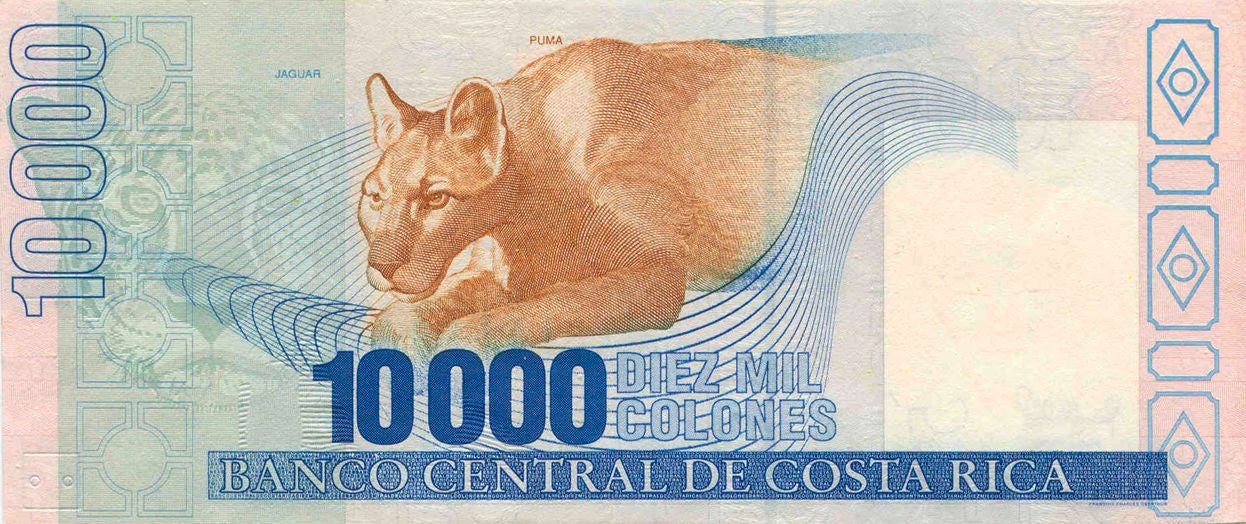
Banknotes issued before 2011
| Denomination | Size (in mm.) | Out of circulating banknotes series | Material | End date of circulation |
|---|---|---|---|---|
| ₡2.000 | 132 long * 67 width | A | Cotton | May 1, 2022 |
| ₡5.000 | 139 long * 67 width | A y B | Cotton | May 1, 2022 |
| ₡10.000 | 153 long * 67 width | A | Cotton | October 1, 2022 |
| ₡20.000 | 153 long * 67 width | A | Cotton | February 1, 2022 |
| ₡50.000 | 160 long * 67 width | A | Cotton | February 1, 2022 |