1.000 colones banknote
Our ¢1.000 bill. The Central Bank of Costa Rica offers new banknotes that incorporate security features identifiable simply by touching, looking at, and tilting the bill.

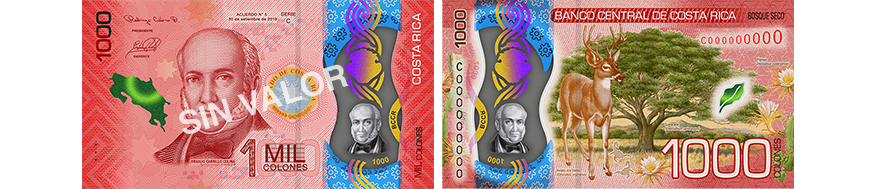
You may check the new banknotes with this simple procedure:
Touch - See - Turn around.
The following video of the new series of banknotes may help you better understand this system and distinguish its security features.
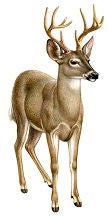
In Costa Rica, the tropical dry forest is found in the lowlands, from 0-700 meters above sea level (MASL), in the Guanacaste province and in the northern part of the Puntarenas province, in the surroundings of River Tarcoles. This ecosystem changes gradually toward the south, as climate conditions there favor the tropical rainforest.
A marked dry season, stretching from November to March, is the main factor conditioning species adaptations in tropical dry forests, e.g. leaf falling to reduce water loss, animal migration toward wetter zones, and an abundance of cacti. During the rainy season the loss of humidity is intensified by heavy trade winds, thereby favoring dispersal of certain seeds.

During the rainy season, the dry forest receives 900-1700 mm of rainfall annually. With the arrival of rains, the forest changes radically: with an increase in humidity, leaves come out and forests are covered with green, there is less light available within them, and many seeds sprout.
Animals that had moved away in search of water and food come back for breeding. Birds sing while building their nests, indicating that the time has come to nest and raise their chicks.
Fauna in these forests is as rich as its flora. It is home to howler monkeys, spider monkeys, white-headed capuchins, deer, coatis, peccaries, Desmarest's spiny pocket mice, Central American agoutis, cougars, armadillos, magpies, trogons, parrots, and a great diversity of insects and spiders, among other groups.
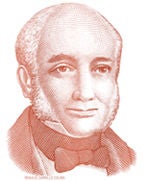
Braulio Carrillo was born in San Rafael de Oreamuno, Cartago, on the 20th of March 1800. He studied Law and graduated as an attorney. He was a Magistrate for the Supreme Court of Justice, which he then came to preside. He was elected as Deputy to Congress, and in 1828 became President of Congress. Additionally, Carrillo represented Costa Rica before the Federate Congress.
Carrillo was Head of State on two occasions. From 1835 to 1837 and again in 1838 as a result of a coup d’état. He was recognized as President by Congress on the 26th of June, was sworn two days later, and remained in power until 1842. He ruled with an iron fist, instilling values like honesty, morality, and hard work. Carrillo enthusiastically promoted the country’s development, bringing about progress and order in Public Administration.
During his administrations, he abolished the so-called Ambulance Law (Ley de la Ambulancia.) He firmly fought idleness and vice, abolishing holidays and religious festivities to this end. He also paid off the country’s foreign debt, and on the 8th of November 1838 he broke ties with the Central American Federation, declaring Costa Rica "a free and independent State."
Under his administration, the road to Matina was built and inaugurated, thereby saving the country in costs for exporting coffee through the Pacific coast. He also enacted the so-called Carrillo General Code (Código General Carillo), the first piece of legislation containing rules on civil and criminal law with their respective procedures, and set up the Judicial System. It was this way that Braulio Carrillo completed the country’s independence from Spain -until that time, it was Spanish laws that were enforced. He ordered by decree the creation of the courts of justice and juzgados, and established custom tariffs and regulations for the public treasury and for the Police. In 1842, Francisco Morazán invaded Costa Rica and Carrillo was deposed. He sought exile in El Salvador, where he was killed on the 15th of March 1845. In 1971 he was declared a Distinguished Citizen and Architect of Costa Rican State by Congress.
Source: Osvaldo Valerín Ramírez, Historian
Download the official banknote brochures containing more information on new banknotes.
Our ¢1.000 bill. The Central Bank of Costa Rica offers new banknotes that incorporate security features identifiable simply by touching, looking at, and tilting the bill.
Brochure for the new 1.000 colones bill. More secure. More durable. Recyclable material. Check both sides of the banknote in three easy steps.